
Inari OGDP
Overview & Location
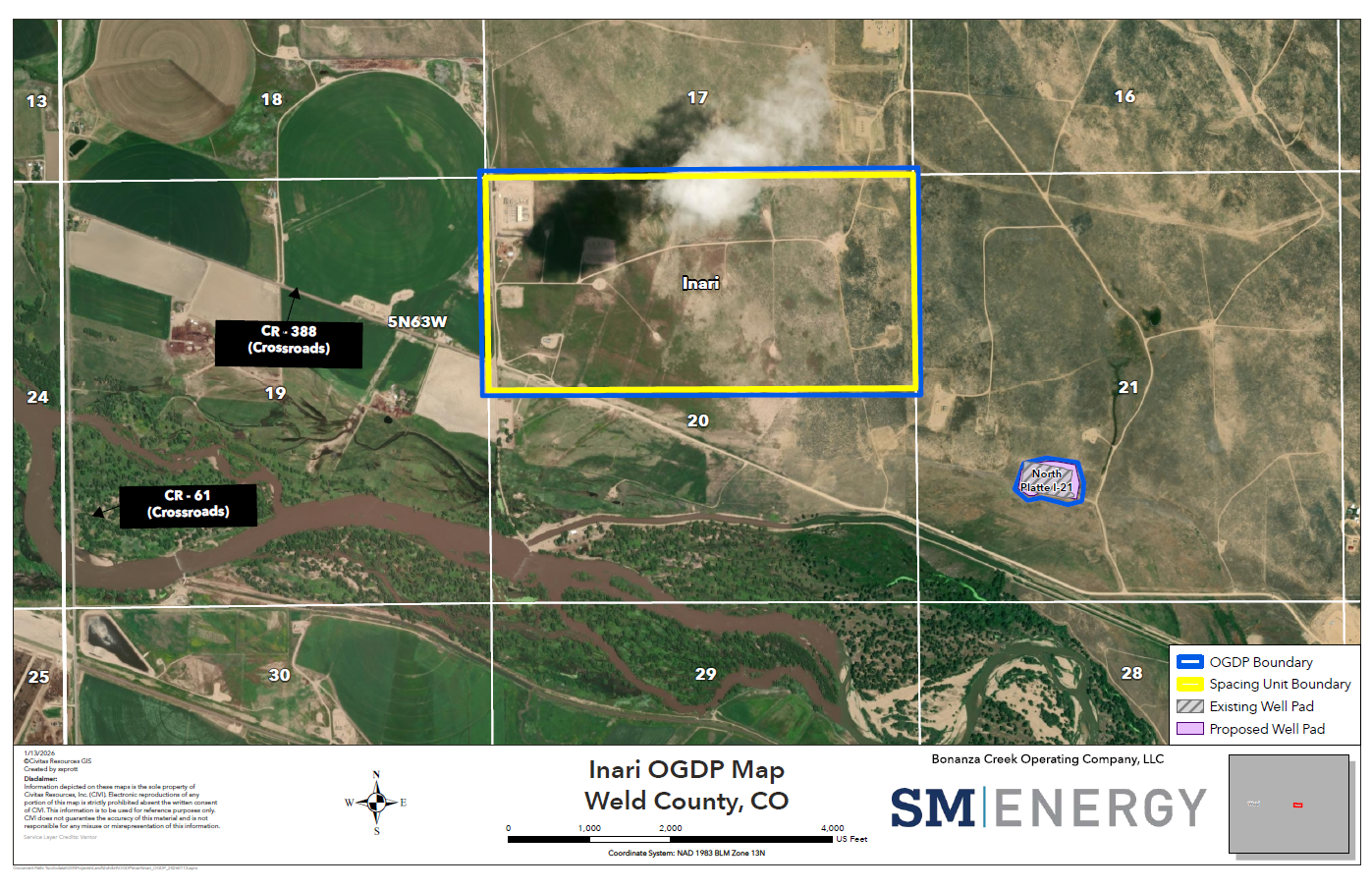
The North Platte I-21 Pad is located near the intersection of Highway 34 and County Road 61 in Weld County and is co-located with existing infrastructure. The proposed pad will occupy approximately 11.42 acres during pre-production (drilling and completions), scaling down to approximately 2.88 acres during production. The plan proposes one drilling spacing unit and will include up to six (6) new horizontal wells or three (3) U-turn wells.
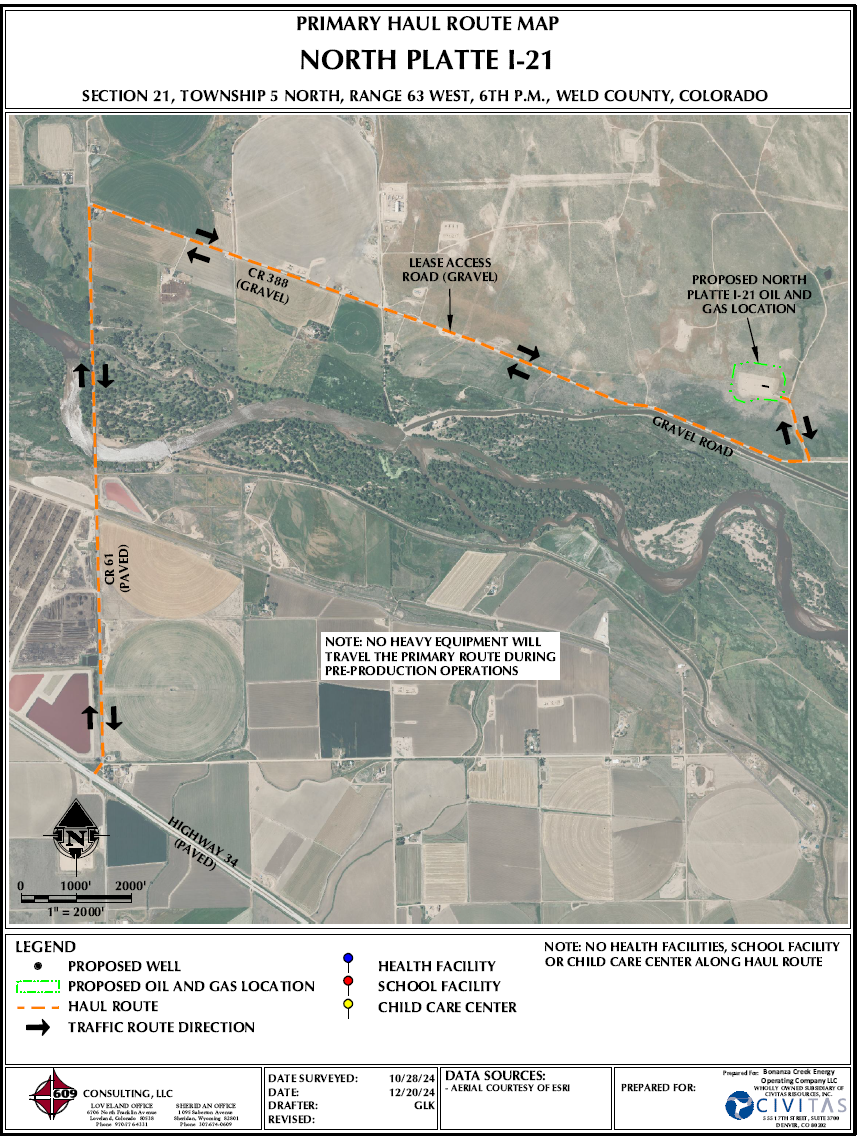
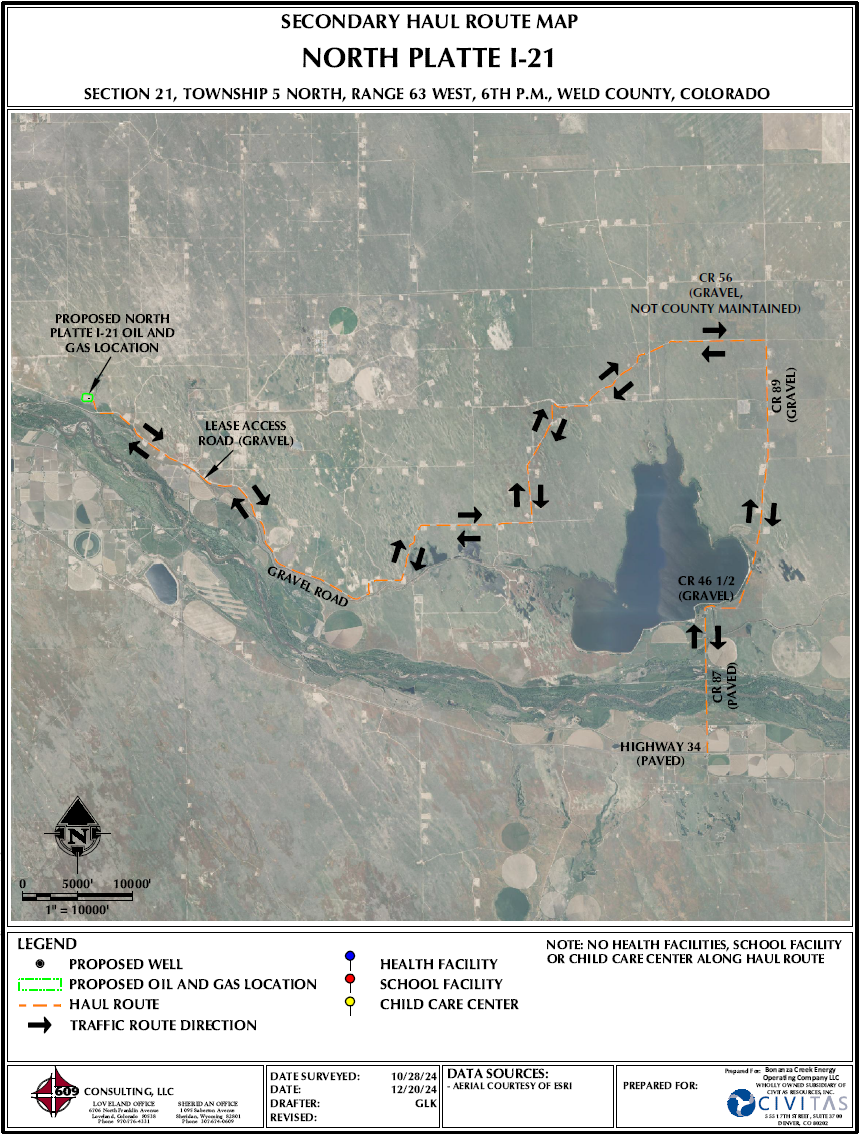
SM Energy developed the proposed primary and secondary haul route to minimize the traffic in the area for our pre-production operations (construction, drilling, and completions). The proposed primary haul route utilizes Weld County Road 61 and Weld County Road 388 before accessing Highway 34. The secondary haul route utilizes Weld County Road 89 to Weld County Road 46.5 to Weld County Road 87 before accessing Highway 34.
Access to the site will through two different access points. Since the proposed location is an expansion of an existing location, SM Energy will utilize existing permitted access points for each route.
The first will be directly onto WCR388 (gravel) to WCR 61 (paved). This route will be utilized by approximately 75% of the expected traffic.
The second route will be accessed via WCR 89, heading West off of WCR 89 on WCR 56. This route will be utilized by approximately 25% of the expected traffic.
Anticipated Timeline
The following timeline intends to inform the sequence and timing of upcoming operations on the Inari. We anticipate a 12-month cycle time from drilling to production. These different stages of the timeline adhere to best-in-class operations and mitigation practices, which are outlined in the timeline details.
This process will include construction of sound walls to minimize disturbance to the surrounding area. The process of constructing the pad and the sound walls is expected to be completed in late 2026.

Next we will drill the wells. During this process, we will construct multiple layers of steel and cement casing around each well to ensure wellbore integrity. The drilling rig will be visible and you should expect to see our crews in the area, as well as downcast lighting and additional truck traffic.
Best-in-Class Operations and Mitigation:
The drilling rig(s) that will be utilized to drill the wells to total depth will be powered by utility power. This lowers the emissions and noise levels that are typically associated with this phase of exploration.
Extraction will employ pipe cleaning procedures when removing drill string from the well and remove drill cuttings daily.
This process reduces the potential for odor impacts during the drilling.
Extraction will utilize Group III drilling fluids, Greatly reducing the potential for odor impacts during drilling operations.
Utilize closed-loop, pit-less fluid management system, greatly reduces odor and emission impacts.

Once drilling is complete, the rig will leave the site. We will spend the next thirty days completing each well and preparing to bring them online.
Best-in-Class Operations and Mitigation:
Extraction will utilize Tier IV or equivalent rated completion equipment.
This will greatly minimize the cumulative impacts to air resources that are associated with the use of internal combustion engines.
A “quiet completions fleet” will be used for hydraulic fracturing operations.
This process greatly reduces the noise levels that are associated with this phase of exploration.
Flowback will be routed through permanent production equipment,
reducing emissions traditionally associated with the flowback phase.

During this phase, all excess operational equipment will be removed from the site. Only the wellheads and associated facilities will remain. To ensure safety and environmental compliance, the wells will be monitored 24/7 through automated remote equipment.

Once the wells are producing, there will be little to no associated traffic on a day-to-day basis. The pad area will be reduced and the surrounding area will be reclaimed with native vegetation. The wells will continue to produce for up to 30 years.
Best-in-Class Operations and Mitigation:
Extraction will install an oil pipeline to the location prior to first production,
eliminating truck traffic and associated emission related to the transfer of oil off of location.
Extraction will install a produced water pipeline to the location prior to first production,
eliminating truck traffic and associated emission related to the transfer of produced water off of location.
Extraction will utilize compressed air pneumatics for all pneumatic actuation on location,
eliminating the use of natural gas vented to the atmosphere during valve actuation and associated processes.
Extraction will utilize a pressurized maintenance vessel during maintenance operations,
eliminating gas that would otherwise be vented to the atmosphere during maintenance operations.
Operator will utilize a tankless design, eliminating emissions associated with oil and water storage and processing tanks.
Operator will electrify the permanent production facilities, minimizes noise and eliminating emissions from production equipment that are normally powered by internal combustion engines.
Operator will not install permanent lighting.

Note: The times provided are estimates and are subject to local authorization. We will keep you informed of any significant changes to our plans.
Air Quality – Air Monitoring
SM Energy is committed to responsible oil and natural gas production and to finding solutions, making investments, and adopting new technologies to safeguard public health, the environment and quality of life for all Coloradans. As part of this commitment, we are adopting new technology to improve air quality. This includes:
Smart Engineering to Lessen Our Impact
-
- Cleaner, best-in-class engines: During drilling and completion operations, SM Energy will use the cleanest available engines, Tier IV, similar to the newest, most efficient truck engines.
- “Tankless Design”: SM Energy will utilize the existing oil and produced water pipelines on location to transport the production and waste from the new wells. This process significantly reduces emissions associated with truck traffic and storage tanks. It also mitigates any potential odor associated with the transportation of oil and produced water by tanker trucks.
- Using electricity: We're always looking for ways to switch from gas or diesel power to cleaner electricity wherever it makes sense. The facility on the pad will run on electricity for the life of the pad.
Checking for Leaks and Keeping the Air Clean
- Regular checks by sight, smell, and sound: During all phases of our work, our teams regularly walk around and carefully look, smell, and listen for any signs of leaks from equipment that holds oil, gas, or chemicals.
- High-tech leak detection with special cameras: We have a strong program to find and fix leaks quickly. We use special cameras that can "see" gas leaks that we can’t. We start using these cameras during drilling and continue checking for leaks throughout the entire life of the site.
- Government approval for air monitoring: The plan for monitoring air quality must be reviewed and approved by Colorado's main health and environmental agency, the Colorado Department of Public Health and Environment. This ensures the proposed methods meet strict state and local standards for keeping the air clean.
Assessment of Potential Public Health Effects from Oil and Gas Operations in Colorado
Ground Water Protection
The protection of water resources in relation to oil and natural gas development has been studied extensively for decades and is actively regulated by environmental officials at all levels of government. All SM Energy projects meet and/or exceed water standards set by the Colorado Energy and Carbon Management Commission (ECMC).
Prior to drilling, the company measures water tables to monitor impact, then uses a protective casing and cement around wells past the water table. Monitoring wells are tested on a prescribed cycle to ensure local freshwater resources are protected. Water quality is tested prior to drilling to establish a baseline, and monthly testing continues throughout the drilling and completion phase. Finally, SM Energy conducts a test six months after production as a last method of verification to ensure the integrity of its operating assets.
- Lining the Ground during drilling and construction: We put down a heavy-duty plastic sheet (a polyethylene liner, like a thick tarp) on the ground. This stops any spills from potentially soaking into the soil or reaching nearby water.
- Building a safety barrier around equipment: A containment system is built around separation equipment and tanks to ensure if a leak occurs, there will be no impact to the environment.
- Having a spill prevention plan: We create a detailed plan specifically for each site that explains exactly how we'll prevent spills and what we'll do in the unlikely event one happens.
Consistent with regulatory requirements and industry best practice, SM Energy discloses its hydraulic fracturing fluid ingredients at FracFocus.org.
Noise
- Thirty-two foot sound walls will be constructed around the majority of the well pad area.
- A "quiet completions fleet" will be used for hydraulic fracturing (completions) operations.
- Production operations will use low noise electric motor drive equipment instead of engine driven equipment.
- The wells will flow back directly to the permenant facility.
- Permanent production facility will be powered by grid power.
Light
- Lighting will be angled downward to limit the halo effect off location and placed at reasonable heights to limit spillage off location.
- Thirty-two foot sound walls will also minimize lighting impacts to surrounding receptors.
- No lighting will be present on the permanent production facility.
Minimizing Odor
- Sealed Fluid Management:
- SM Energy uses a "closed-loop" system, meaning all drilling fluids are contained and recycled, eliminating open pits that can emit odors.
- Odor-Conscious Materials:
- SM Energy specifically choose Group III drilling fluids, known for their very low odor profile. We also remove drilling waste daily.
- Modern Facility Design:
- SM Energy will utilize electric power for production facilities which eliminates potential odors from on-site combustion engines.
- SM Energy will utilize instrument air for pneumatic controls and a pressurized maintenance vessel for maintenance operations, which eliminates gas that would normally be vented to the atmosphere during these operations.
- SM Energy will utilize the existing oil and produced water pipelines to the location to transport the production and waste from the new wells. Reducing odor emissions associated with truck traffic, transfer of oil and produced water from storage tanks to tanker trucks, and venting from storage tanks.
Any Questions?
Please do not hesitate to contact us with questions about this proposed development. You can reach us via email at smcommunityrelations@sm-energy.com, by phone 720-279-9842 or by using the below contact form.